The Friction Was the Point
- Stephen Jones
- February 9, 2026
Table of Contents
My dad had a camera. Not a phone with a camera. A camera. A proper one with a roll of film that gave you 24 shots, maybe 36 if you were feeling extravagant.
Every photo was a decision. You’d frame the shot, think about whether it was worth burning one of your remaining exposures, and press the shutter with intention. Then you’d wait, sometimes weeks, to see if the moment you remembered matched the image on the print.
Those photos meant something. Not because the camera was better. Because the constraint forced you to care.
At our wedding, we put a disposable camera on every table. The idea was simple: let the guests capture the moments we’d never see ourselves. Those photos were imperfect. Some blurry, some badly framed, a few completely inexplicable. But every single one was someone choosing to spend one of their limited shots on something that mattered to them. I still look at those photos. They have a sense of honesty.
You wouldn’t do that now. You’d set up a shared album and ask people to upload from their phones. You’d get 2,000 photos and look at none of them.
Ten thousand photos of nothing
Then the iPhone happened.
Suddenly you could take 200 photos of the same sunset and figure out the best one later. Except you never figured out the best one later. You just accumulated.
I’ve got tens of thousands of photos on my phone right now. I almost never look at them. They sit there in an infinite scroll of moments I technically captured but never really kept.
The scarcity of film did something we didn’t appreciate at the time: it forced curation before capture. You had to decide what mattered in real time. That decision, that tiny act of choosing, was what made the photograph an artefact instead of just another file.
We traded that for volume. And volume, it turns out, is not the same thing as value.
The bookshop you’ll never browse again
The same pattern played out with books.
There was something about walking into a bookshop and browsing the shelves. You’d pick up a book because the cover caught your eye, or because it was next to something you were already looking for. You’d read the first page standing in the aisle and either put it back or carry it to the counter. The discovery was messy, inefficient, and personal.
Then Amazon showed up with “customers who bought this also bought” and curated recommendation engines. Finding a book became effortless. The algorithm knew your taste better than you did.
Except it didn’t. It knew your history. And there’s a difference.
An algorithm optimises for similarity. A bookshop browsing session optimised for surprise. The book you didn’t know you needed, the tangent that reshaped how you thought about a problem, the accidental discovery that became your favourite. Those came from the friction of wandering without a clear destination.
Amazon gave us everything we wanted and took away everything we didn’t know we needed.
The meeting nobody remembers
Now fast-forward to right now.
Every meeting gets recorded. AI transcribes it in real time, generates a summary, extracts action items, and delivers a neatly formatted set of notes to your inbox before you’ve even closed the browser tab.
Sounds brilliant. It is brilliant, technically.
But here’s the thing I keep coming back to: when someone was scribbling notes by hand in a meeting, they weren’t just recording. They were processing.
Handwriting forces you to listen, filter, and decide what matters in real time. You can’t write fast enough to capture everything, so your brain does something remarkable: it compresses. It extracts. It synthesises. The act of writing was an act of understanding.
AI transcription removes that entirely. You get a perfect verbatim record and zero cognitive engagement. The transcript is complete. Your understanding is empty.
And I’ll be honest, I’ve caught myself doing exactly this. “I’ll just check the transcript later.” Later never comes. Or it does, but skimming a transcript is not the same as having been present in the conversation with your brain switched on.
The notes you took by hand were worse than a transcript. They were incomplete, messy, and sometimes illegible.
They were also the only version you actually remembered.
The pattern nobody talks about
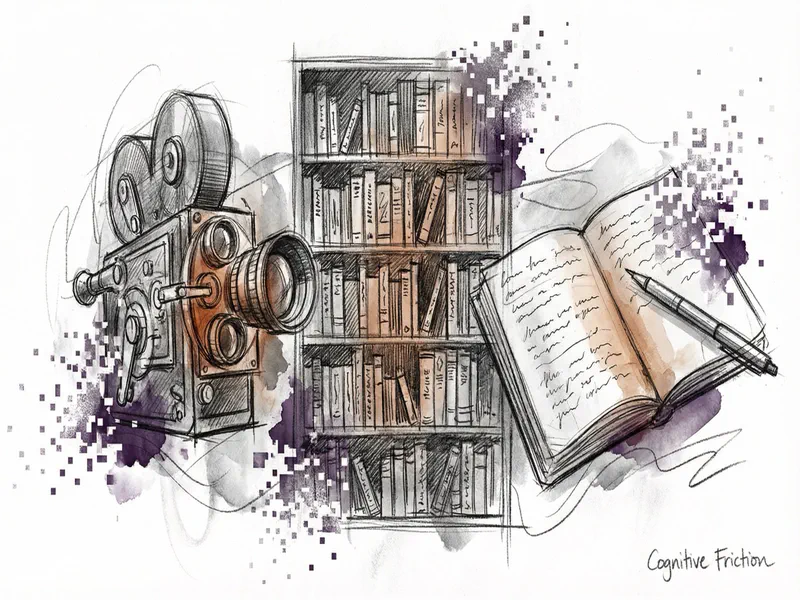
These three examples (film cameras, bookshops, meeting notes) look different on the surface. But they’re the same story told three times:
Every time we make capture effortless, we lose the thinking that effort forced us to do.
The friction wasn’t a bug in the old system. It was doing cognitive work on our behalf that we didn’t notice until it was gone.
- Film forced curation before capture
- Bookshops forced discovery through wandering
- Handwriting forced comprehension through compression
Remove the friction, and you don’t just make the task easier. You remove the thinking that the task was quietly demanding of you.
This is not an anti-technology argument
I want to be clear about something. I use all of these tools. I take thousands of photos on my phone. I buy books on Amazon. I use AI transcription.
The tools aren’t the problem. The problem is mistaking recording for understanding.
A photo is not a memory. A recommendation is not a discovery. A transcript is not comprehension.
We’ve built an entire generation of tools that are spectacularly good at capture and spectacularly bad at making us engage with what we’ve captured. And because the capture is so effortless, we assume the value is there somewhere, stored safely, available whenever we need it.
It isn’t. The value was in the effort. The effort is gone.
So what do you actually do about it?
I don’t have a framework for this. I don’t have a five-step methodology. But I’ve started doing a few things deliberately:
In meetings, I’m back to taking handwritten notes for the ones that matter. Not because the AI transcript isn’t useful, it is, but because I know that if I don’t force myself to synthesise in real time, I’ll walk away with nothing. The transcript is my backup, not my primary.
With photos, I’ve started doing something my dad did without thinking about it: I delete. Ruthlessly. After a trip, I spend twenty minutes picking the ten photos that actually tell the story and I let the rest go. The curation that used to happen before the shutter now happens after.
With reading, I will seek out bookshops or the library. Not because it’s efficient, it isn’t, but because the algorithm will never show me the book I didn’t know I was looking for.
The common thread is intentional friction. Deliberately choosing to do the hard cognitive work even when a tool means you don’t have to.
The bigger picture
We’re in the middle of the biggest friction-removal project in human history. AI is automating summarisation, synthesis, creation, curation. Every cognitive task that used to require effort.
Most of the time, that’s genuinely good. I don’t want to go back to manually parsing CloudTrail logs when an agent can do it in seconds.
But some friction is load-bearing. Some effort is where the understanding lives. And the hardest part of this era isn’t building the tools that remove friction. It’s developing the judgement to know which friction to keep.
That’s not a technology problem. That’s a human one.
I hope someone else finds this useful.
Cheers